
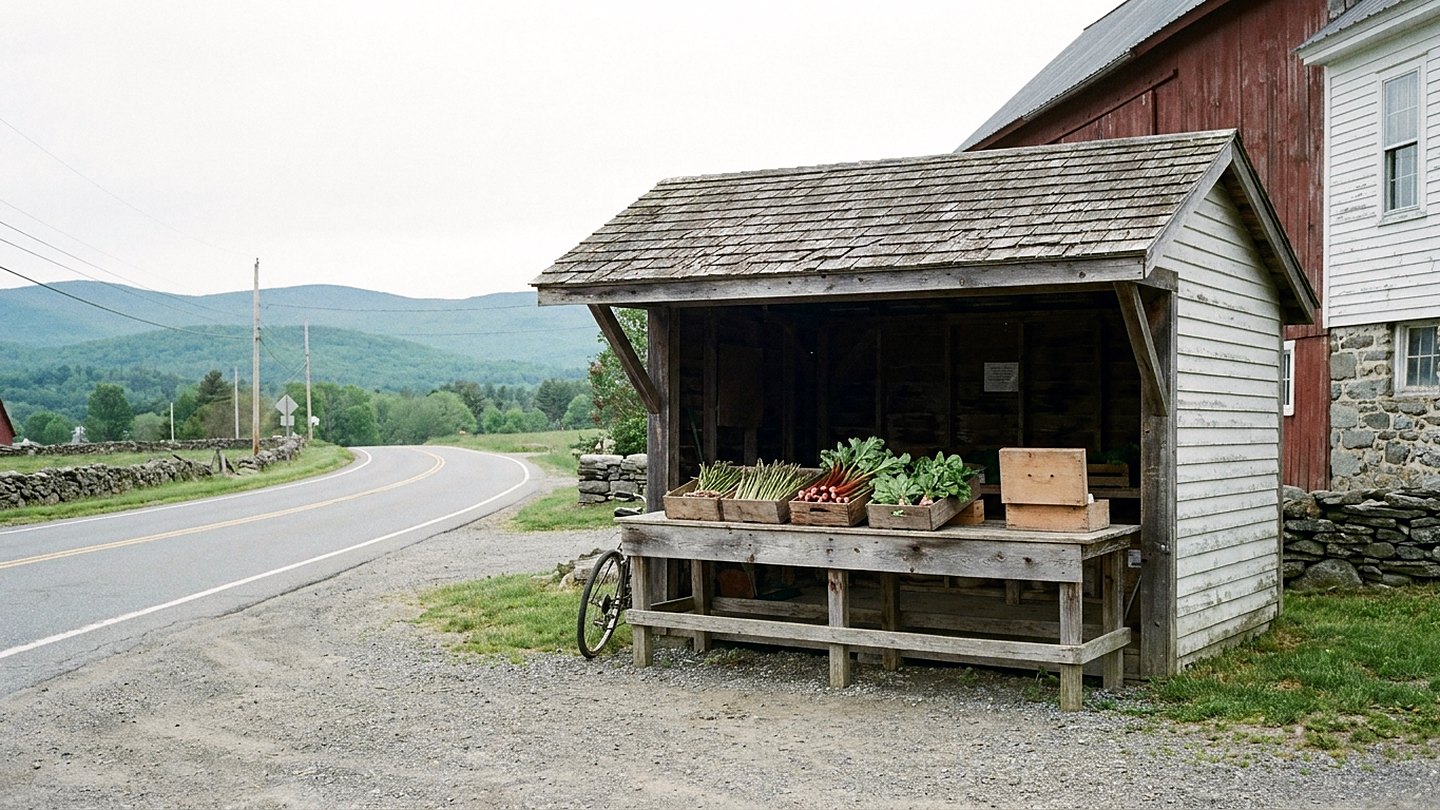
One Hour at a Roadside Farm Stand
I drove north for forty minutes to watch an honor box do its job for one full hour. Nineteen vehicles slowed, and my notepad filled faster than the crates emptied.
For six years I have driven past this stand without slowing down once. It sits on a state route north of Manchester, on the outside of a long curve. There is an awning, a counter built from an old door, and a sign painted by hand.
The errand was narrow on purpose. I wanted to stand near an honor box for one full hour and record what people actually did. Not what the sign asks of them, and not what anyone would report afterward. Just the hour, the cars, and the box.
I chose a Wednesday in the third week of May, because the stand posts its opening week on a card each spring. That card named asparagus and rhubarb and nothing else. I appreciated the restraint, which is rarer than it should be.
Getting there and parking badly
I left Manchester at 8:04 and reached the pullout at 8:44. The drive is unremarkable in the good way: two lanes, one long climb, a bridge with a steel rail that hums under trucks.
The pullout is gravel and holds four vehicles if everyone is honest about the geometry. I parked crookedly on the first attempt, corrected, and then watched three other drivers do exactly the same thing. The gravel slopes toward the road, so anything with a light front end wants to creep forward. Everyone leaves it in gear.
The stand opens at nine. At 8:52 a woman in a green truck arrived, lifted the awning arms, and set out six crates. She nodded at me the way you nod at a parked stranger, politely and without any commitment. Then she drove away and left the whole operation to itself.
How the box is built
The box is the most engineered object at the stand. It is a steel cash box bolted through the counter with two carriage bolts, and the bolt heads have been rounded over with a file. Someone took real time to do that. The lid never opens; instead a slot the width of a thumb has been cut through the top.
Beside the slot sits a coffee tin full of loose coins and a card asking you to make your own change. That was the part I did not expect. The tin is open, the coins are visible from the road, and nobody watches either one.
Every crate carries a strip of wood clipped to the front and marked in thick black marker. I am not going to copy those numbers here, because they will be wrong by August anyway. What matters is that each strip names a unit: a bunch, a quart, a half dozen. Nothing here is sold by weight, so there is no scale to argue with.
A spiral notepad hangs from a string, mostly used for messages. Two entries from the previous week read "back Friday for eggs" and "left extra, took two." A third said thank you for the rhubarb and gave no name at all.
Nineteen vehicles in sixty minutes
I started counting at 9:00 and stopped at 10:00. Nineteen vehicles slowed enough to signal, and fourteen of those actually stopped. Eleven people bought something. Three looked, photographed the hand-painted sign, and drove off again.
The rhythm was not steady in the slightest. Seven stops came between 9:00 and 9:15, and exactly one came between 9:30 and 9:45. There was a commute buried inside the first quarter hour. After that arrived a slower group who walked down from a house up the hill, twice, with a wheelbarrow on the second trip.
The average stop ran just under four minutes. The longest lasted eleven, and it belonged to a man who telephoned home from the counter to ask which greens were wanted. He read the wooden strips aloud, one at a time, with the patience of someone who has been wrong about greens before.
Two drivers assumed I worked there. I told them I did not, and both kept talking anyway, which is how I learned that one of them has been stopping here since the stand was a card table.
What goes first
Asparagus went first, and it was not close. Two bunches left within four minutes, and by 9:20 the crate held only the short spears at the bottom.
Rhubarb went second, in long red stalks with the leaves already cut off into a bucket. Nobody touched the bucket. Eggs went third, out of a cooler with a brick holding the lid down, and they moved quickly and quietly between 9:10 and 9:40.
What stayed behind was the spinach, which had been rained on, and a crate of last autumn's squash. I suspect that squash is closer to decoration than inventory at this point. One woman picked up a squash, turned it over twice, and set it back with visible regret.
If you want a rule out of this, here is the only one I trust. At a stand in late May, whatever grew this week leaves first, and whatever survived the winter leaves last.
The restock, and four minutes of talk
At 9:48 the green truck returned. The woman refilled the asparagus from a cooler in the bed, straightened the wooden strips, and emptied the box into her coat pocket without counting a thing.
I asked how often the box comes up short. She said it happens, maybe four times in eleven years that she noticed, and twice people had left more than the strips asked for. She added that the coin tin has never gone missing, then looked at the tin as though she had just cursed it.
I asked why the bolt heads are rounded over. A neighbor did that, unasked, during the week the stand first opened. That is the entire security system: two filed bolts and a road watched by everyone who lives along it.
Worth the errand
Yes, with conditions. An hour is the correct length for this, and thirty minutes would have shown me a completely different stand.
Bring small bills, because a coin tin cannot solve a large one. Bring a bag, since the stand offers used paper sacks and runs out of them by midmorning. Go on a weekday if you want the rhythm, and on a Saturday if you mostly want the produce.
It will not suit everyone. There is no restroom and no shade after eleven. The pullout is loose gravel on a slope, which is hard work with a walker, a stroller, or a cane. The counter stands high and the crates sit on the ground below it. Hours are short in May, roughly nine to noon, and the stand closes outright in heavy rain.
If you go hoping to meet the farmer, understand that you may not. The stand is built to run without her, and that is the point. After an hour of watching, I think it is a quietly impressive piece of design.
What I checked
- New Hampshire Department of Agriculture pages on farm stands and direct farm sales
- Town pages for the host town, including road notices and posted seasonal hours
- State farm bureau pages listing harvest dates for late May in southern New Hampshire

Asma Tarrant, founder and editor. Filed from Manchester, New Hampshire.