
Four Places on One Hill
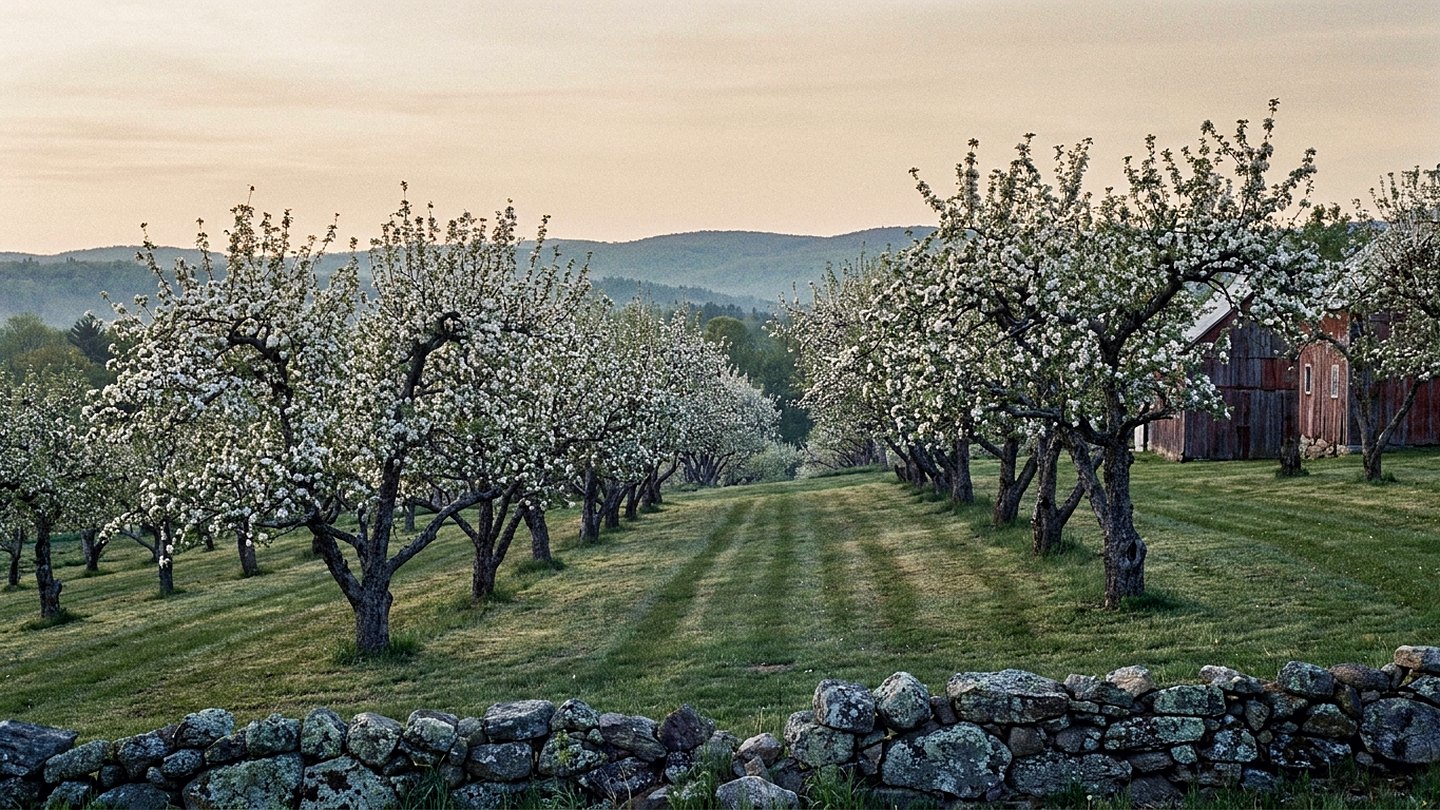
An orchard hill north of Manchester in bloom, in July, at picking time, and in February. The same rows, four different places.
The hill is about thirty-five minutes north of Manchester, and I have been up it twelve times in three years, which works out to one visit a season, year after year. It is an apple orchard on a slope that faces roughly southeast, with the rows running across the hill rather than down it, which I did not notice at all for the first two visits.
I go because it is the clearest example I know of a place that is four places. Not four moods, not four kinds of light. Four different places, with different sounds, different smells, different numbers of cars in the lot, and different reasons to be standing there.
Most people see it once, in September, in the middle of the day, with a paper bag. That is a good visit. It is also the visit that hides the other three.
May, the week of bloom
Bloom lasts about a week and the week moves. In three years I have hit it on May 12, May 18, and May 9, which is a range wide enough to make planning honest work rather than a matter of picking a date.
The first thing is not the color. The first thing is the sound. Every tree on the hill is running at full volume with bees, and the sound sits at about chest height and does not move. Stand in a row for a minute with your eyes closed and it is a low steady hum with individual notes crossing it. It is the only time of year the orchard makes noise on its own.
The color, when you get to it, is not the white you expect. It is white with pink underneath, pinker at the edges of the petals and on the buds that have not opened. From the bottom of the hill the whole slope reads as pale gray green, and you have to walk twenty rows in before it reads as flowers.
The lot had four cars on my last bloom visit. Two of them held photographers. One held a man eating lunch in his truck with the door open, entirely uninterested in the flowers, which I respected.
July, when nothing is happening
July is the visit nobody makes, and it is my favorite one to write about because there is so little to say and saying it takes effort.
The hill in July is green in the flat, unremarkable way that a lawn is green. The apples are there, marble-sized to golf-ball-sized, hard, matte, and the exact same color as the leaves. You can stand two feet from a loaded branch and count six apples where there are fifteen. It takes practice to see them and there is no reward for the practice.
What July gives you instead:
- The rows are walkable and completely empty, all three times I have tried
- The grass between rows is mowed short, so footing is even
- Heat pools on the slope by eleven in the morning and the tree shade is genuinely cool
- You can see the shape of the hill itself, which the flowers and the crowds both hide
I stayed an hour on my last July visit and saw one other person, who was working, on a small tractor, and who waved in the manner of someone who has decided that waving is faster than a conversation.
September, the loud month
September is the version of this place that exists in most people's heads, and it earns it. On a Saturday the lot overflows onto the shoulder of the road for about two hundred yards, there is a person directing cars, and the wait to get a wagon out to the rows runs fifteen minutes or so.
The smell is the thing. It is not the apples on the trees, it is the ones on the ground, warm, fermenting slightly, sweet in a way that gets heavier by afternoon. You smell it before you are out of the car.
The rows closest to the lot are picked bare by ten in the morning and stay that way. Walk eight minutes uphill and you are in loaded trees with nobody in them. I have watched families give up at row four on every Saturday visit and I have stopped feeling superior about it, mostly.
A Tuesday morning in the second week is a completely different day: maybe six cars, no one directing traffic, the same fruit. I put that in writing every year and I still meet people who only go on Saturdays.
February, the empty version
February is when the hill is most itself, and I say that knowing how it sounds.
The trees are bare and pruned, and the pruning is the point. In leaf you cannot see how heavily these trees are cut. In February you can see every decision: the open centers, the cuts angled to shed water, the young growth taken back to two buds. Someone spent a great many cold hours up here with a hand tool, and the whole hill is the record of it.
The rows hold snow in long white stripes with brown grass showing at the crowns. Sound carries an unreasonable distance. On my last February visit I heard a dog, a chainsaw, and a truck downshifting, and all three were far enough away to be invisible.
There is nothing open. There is no reason to be there in the ordinary sense. The lot is plowed to about half its size, and on two of my three winter visits mine was the only car in it.
What the four places add up to
The honest summary is that a place does not have a character. It has four of them, and the one you meet depends on a decision you probably made for convenience.
I also learned that my notes get better as the place gets emptier. My September pages are about logistics and other people. My February pages are about the trees. That is not the orchard changing. That is me having nothing else to look at, which turns out to be a service the place provides for free.
Going back
I will keep to three visits a year: bloom week, one flat July morning, and one February afternoon when the light goes orange around four. September I will do on a weekday or not at all, which is a rule I made after the year I did it on a Saturday and wrote down nothing but parking.
Go in bloom if you want the sound. Go in September if you want fruit and do not mind company. Go in February if you want the hill and are willing to accept that nothing will happen.
A few honest warnings. The final turn into the lot is steep and gravel, and in mud season it is properly rutted. The rows themselves are grass over uneven ground with a real slope, so this is not a smooth-surface walk, and the uphill rows are a genuine climb. Hours are seasonal and short outside of picking, restrooms exist only in the fall, and in February you should assume that nothing on the hill is open to you except the view and the road.
What I checked
- Public pages of the state farm bureau, general seasonal notes on orchard bloom and harvest timing
- Town pages for the road, the seasonal traffic advisory, and posted lot information
- State agriculture pages, general information on pick-your-own operations in New Hampshire

Asma Tarrant, founder and editor. Filed from Manchester, New Hampshire.