
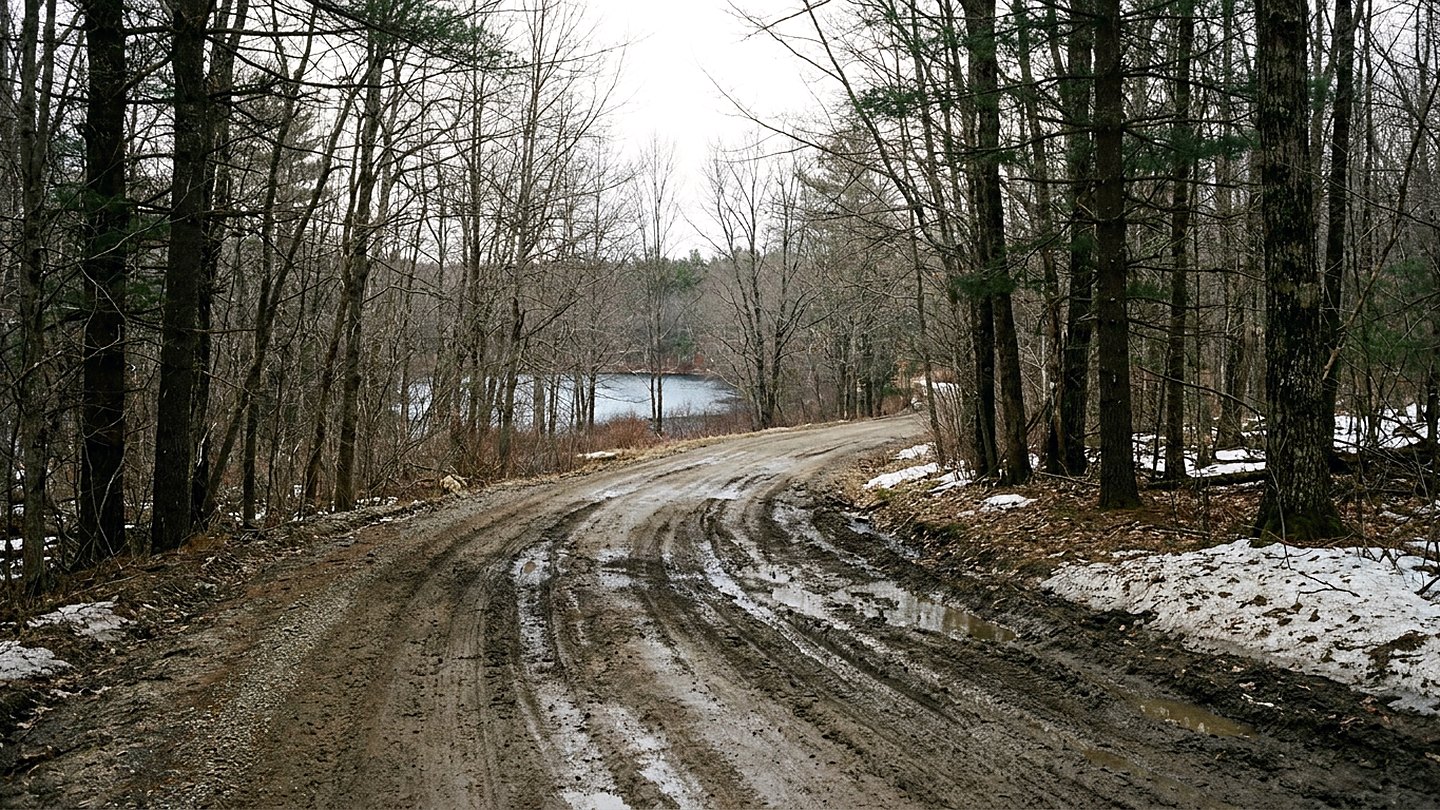
The Lake Road in Mud Season
The same two miles of town gravel in March, May, and August. What the thaw does to a road surface, and what the people who live on it would like you to know.
There is a gravel road about forty minutes west of here that ends at a small lake with a launch and no store. I have driven it in most months of the year, and I still misjudge it about a third of the time. This is a record of the same 2.1 miles in March, May, and August.
The road is a town road, which means the town maintains it with a grader and a budget that does not stretch to pavement. Two cars can pass if both drivers slow down and one of them is generous. In mud season the whole arrangement turns into a negotiation with the ground itself.
I am not going to name the lake, and not for any romantic reason. It is small, the parking holds maybe six cars, and the people who live along that road did not ask for company. The road turned out to be more interesting than the lake, which surprised me the first time I noticed it.
March: the ground gives back
Mud season is a real season here, even if no calendar prints it. Frost goes into the ground for months, then leaves from the top down, and the water it releases has nowhere to drain. The state transportation pages describe this plainly: the road base softens, so towns post weight limits until the ground firms up again.
On March 19 I drove the first mile in eleven minutes, which is slow even for gravel. The surface was a set of ruts eight inches deep with standing brown water in the bottom of each one. In the shaded stretch under the pines the road looked solid and was not. I felt the front end drop and slide sideways before it caught.
I stopped at the height of land, walked forward fifty yards, and decided the rest of it was not mine to try. Tire marks in soft ground stay there until the grader comes, and a car that digs in can hold a road hostage for hours. I backed into a driveway apron, turned around, and drove home feeling like a person who had learned something cheaply.
Two signs on the way out said the road was posted, with weight limits in force. I had driven past both of them unread on every earlier visit. They are not decoration. A loaded truck on a soft base can break a road in one pass.
May: the road remembers
By May 24 the ruts had dried into a permanent record of March. The road held the shape of every bad decision the winter had allowed, including mine. The ridges were hard enough to steer the car for me, which is a strange feeling. Driving it felt like riding in a groove I had helped carve.
Then the grader came through, sometime in the week after Memorial Day, and the whole surface reset. Fresh gravel is loud, pale, and slightly loose underfoot. The corners had a rolled edge, and the crown was rebuilt so water would run to the ditches. The road went back to looking like something a town spends money on.
May is also the month the road gets busy in a modest way. I counted four cars in an hour, two with boats, one with a dog whose head never came inside. Black flies were doing their annual work along the shaded stretch, which is one reason nobody lingers at the launch before June.
The water was still cold enough that swimming was a theoretical activity. Two people fished from the shore for forty minutes and caught what appeared to be a mood.
August: dust and the same view
August is when the road turns to concrete with a coating of powder. I drove in at 8:15 on a Sunday morning and left a plume behind me the entire way. That is the part of gravel driving nobody warns you about. Dust hangs in still air for a full minute, then settles on whatever is downwind. That means gardens, laundry, and open windows.
So you slow down. Twenty miles an hour is fine on the empty stretches and far too fast near the six houses at the middle bend. I once watched a resident stand at the end of a driveway while a car went by at forty. He said nothing at all, and the silence carried the message adequately.
The washboard ripples build up on the two uphill corners by late summer, because that is where tires spin slightly under acceleration. You can feel them through the wheel as a fast shudder. The standard advice, drive faster to float over them, is how people end up in ditches. Slower simply works better.
At the launch the lake was warm at the edges and busy in the way small lakes get in August. I counted four kayaks, one small motor, and a heron holding position on a rock. The view from the launch is identical in every month I have seen it. The road getting there is a different road four times a year.
Small courtesies on a gravel road
Most of what I know now came from doing it wrong once. None of it is complicated.
- Slow to a crawl near houses, mailboxes, and anyone on foot. Dust and thrown stones are the whole issue.
- If you meet the grader, pull over and let it finish its pass. It is working, and you are not.
- In mud season, do not test a soft spot with speed. Stop, look at it, and turn around if it looks doubtful.
- Never spin the tires. A spinning tire digs a hole that somebody else has to fix.
- Park in the marked area only, never across a driveway or a turnaround. Those turnarounds exist for plow trucks.
- Carry out whatever you carried in, including the fishing line.
- Wave at oncoming drivers. It costs nothing and it marks you as someone paying attention.
Going back
I have gone back nine times over two years, and my honest conclusion is short. Mud season is worth seeing exactly once, from a car you are willing to get dirty. Bring a plan to turn around early. It is not scenic. It is a road doing something interesting under stress, which is a narrower kind of interesting.
The road does not suit every vehicle or every visitor. Low-clearance cars will scrape in March and April, and the last half mile stays soft until the middle of May. There are no restrooms, no water, and no lighting after dark, and the cell signal drops out for the last mile.
The launch itself is loose gravel on a grade, and it gets slick when wet. Anyone with balance concerns or a wheeled device will find the shoreline unfriendly, since it is all rounded stone and tree roots. The parking area is flat, at least, and you can see the water from it without walking down.
If you want one visit, take a weekday morning in late September. The dust has settled by then and the leaves are turning above the road. If the road interests you more than the lake, come in March, drive the first mile, and then stop. I plan to do exactly that again this spring, with better boots.
What I checked
- State transportation pages explaining spring thaw and posted weight limits on secondary roads
- Town pages listing road agent contacts, seasonal road status, and public launch rules
- Municipal meeting minutes covering grading schedules and gravel road maintenance

Asma Tarrant, founder and editor. Filed from Manchester, New Hampshire.