
One Table by the Window
A public library one town north keeps a second-floor reading room with fourteen tables. I go there for exactly one of them.
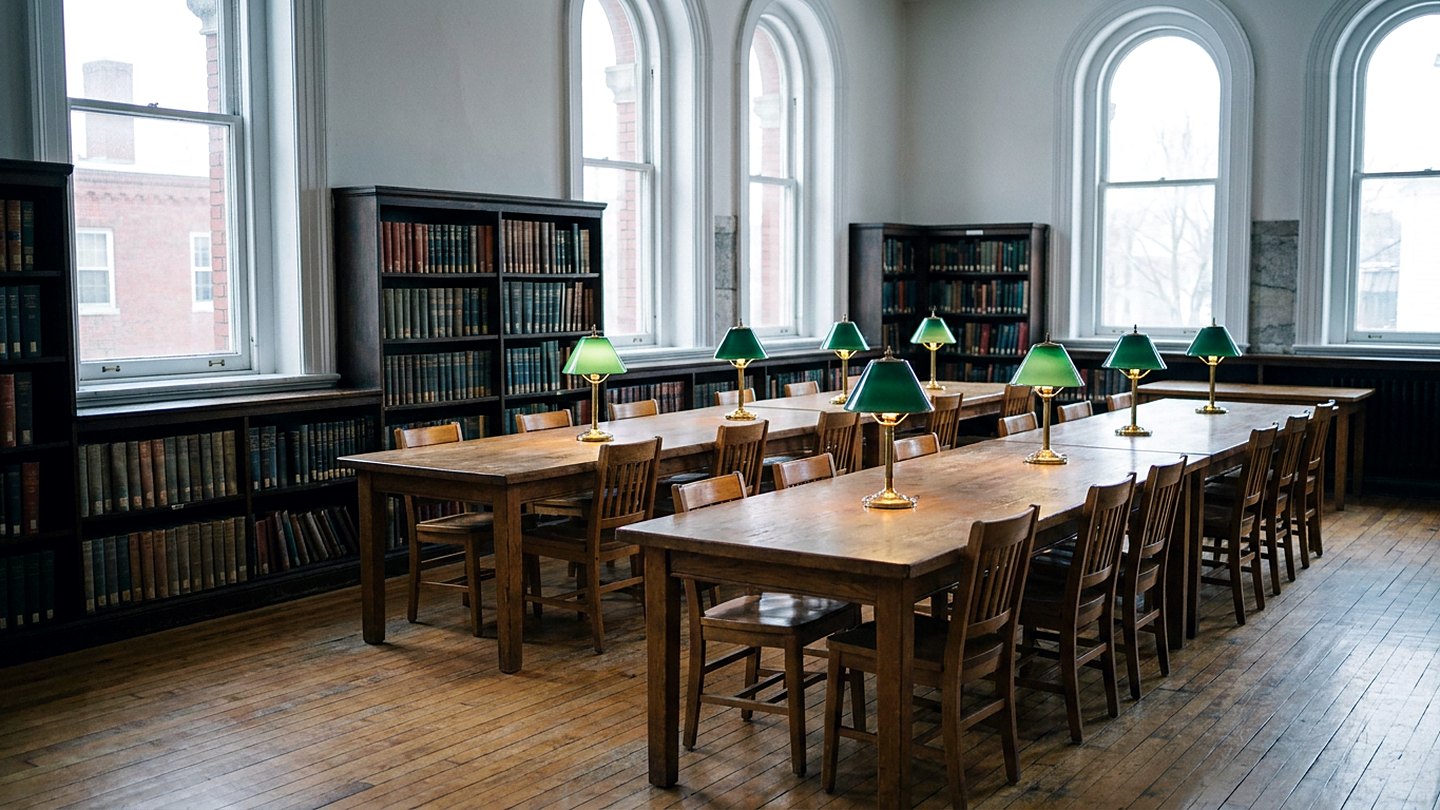
There is a table on the second floor of a public library one town north of me, and the errand is to sit at it. Nothing else is on the list. It stands second from the end of the north wall, under a window that begins at the radiator and ends somewhere near the ceiling. On a January morning that window turns the whole surface a flat, even white, and my handwriting improves for reasons I cannot defend.
I started going in October, when my own building had a month of hallway work and the drills came up through the floor. What I wanted was four consecutive hours containing no decisions at all. The reading room supplied them, so I kept returning, first every week and then whenever the week got loud.
This is a short entry about a short trip. Door to door it costs me roughly five hours, of which two are the table and three are everything else. That ratio sounds indefensible until you actually sit down in it.
Why this table and not the other thirteen
The room holds fourteen tables in two rows of seven, with a wide aisle running between them. Twelve are perfectly good. Two are better, and they are the pair under the north windows, where the light arrives indirectly and stays that way all morning. The other tables sit under fixtures that hum at a pitch I can hear only after forty minutes, which is worse than hearing it right away.
Each table has a low lamp with a green glass shade, and each lamp has a pull chain that makes a small metallic sound. In January the staff turn them on before opening and leave them on until closing, because the daylight here gives up around three. The chain is decorative most of the time. I pull it anyway on the way out, then feel foolish, then do it again the next visit.
The chairs are wooden, unpadded, and slightly too upright, which I have decided is the point. Nobody falls asleep in that room. I have watched people try.
Getting there without a car
The bus leaves from a shelter eight minutes from my door and takes about forty minutes to cover a distance a car does in twenty-five. It stops eleven times. I know this because I counted on the third trip, out of the kind of boredom that turns into a habit.
From the last stop it is a ten-minute walk, uphill for the first four minutes and flat afterward. In winter the sidewalk on the left side gets cleared first, sometimes by seven in the morning, while the right side stays packed and glazed until the sun works on it. The town's public pages are honest that clearing runs on a priority order, and downtown is high on that order, which I appreciate more in February than in June.
If I drive instead, the street parking downtown is free but limited to two hours, and two hours is precisely the length of the errand with nothing left over. That math is why I take the bus. The lot behind the building is signed for library use, holds maybe thirty cars, and fills by ten thirty on weekdays. I have circled it twice and given up twice.
The return bus runs less often after two in the afternoon. I have missed it once and spent fifty minutes in a doorway learning the exact difference between fifteen degrees and twenty-two degrees.
What the room asks of you
The rules are posted by the stairs on a single card, and they are shorter than most restaurant menus. No food. Water is fine if the container has a lid. Phone calls belong in the stairwell or outside. Laptops are allowed everywhere except the four tables nearest the reference shelves, which are marked for reading only.
Nobody enforces any of this loudly. The enforcement is social and immediate. On my second visit a man took a call at his table, said four words, looked up at the eleven faces that had turned toward him, and left the room midsentence. I have never seen a policy work that fast.
What surprises visitors is that the quiet is not total. Radiators tick. The floor above has a heavy door that closes twice an hour. Somebody unzips a bag every few minutes. The room is not silent, it is uninterrupted, and those are different products. Silence would make me nervous. This is closer to sitting near a river.
The staff are used to people who come only for the room and never touch a book. One of them asked once whether I was studying for something, and I said no, I was writing about places I return to. She nodded as though that were an ordinary answer and went back to the cart.
The hours, and the trap inside them
Here is the part I got wrong twice. The building opens at nine thirty on most weekdays, but the second floor opens at ten, because one staff member handles both floors and starts upstairs after the morning holds are shelved. Arriving at nine forty means standing at a stair gate for twenty minutes with your coat still on.
Evening hours run until eight on two weeknights and until five on the others. Saturday closes at one in the afternoon, which is a real trap if you plan a Saturday around it and lose an hour to the walk. Sunday the building is closed entirely from December through March. The library's own pages carry all of this plainly, and I now check them the night before, because winter brings storm closures announced at six in the morning.
The reading room also closes an hour before the building does. That hour exists so the staff can shut down the floor, and it is not negotiable. At seven o'clock on a Thursday the lamps go off one row at a time, which is the most theatrical thing in the entire town.
Worth the errand
For me, yes, and I have done it eleven times now. Five hours of my day buys two hours of a specific quality of attention that I have not managed to reproduce at my own desk. That is poor arithmetic on paper and sound arithmetic in practice.
It will not suit everyone. The reading room is on the second floor, the stairs are the main way up, and while there is an elevator it sits behind the circulation area and runs slowly enough that people take the stairs out of impatience. The chairs are hard. There is no coffee in the building, and the nearest place to get any is a six-minute walk, which means giving up your table in a room that fills after eleven.
If you have small children with you, this is not the errand. If you need to take calls, it is not the errand either. If your day has any flexibility at all, go on a weekday morning at ten, take the left side of the sidewalk, and sit at the north wall.
And if both window tables are taken when you arrive, take the third one and do not sulk. I have tried sulking. The light is the same.
What I checked
- Library hours, closures, and reading room conduct rules from the library's own public pages
- Winter service notes and posted departure times from the regional bus operator's public schedule pages
- Town pages on downtown sidewalk clearing and two-hour street parking

Asma Tarrant, founder and editor. Filed from Manchester, New Hampshire.