
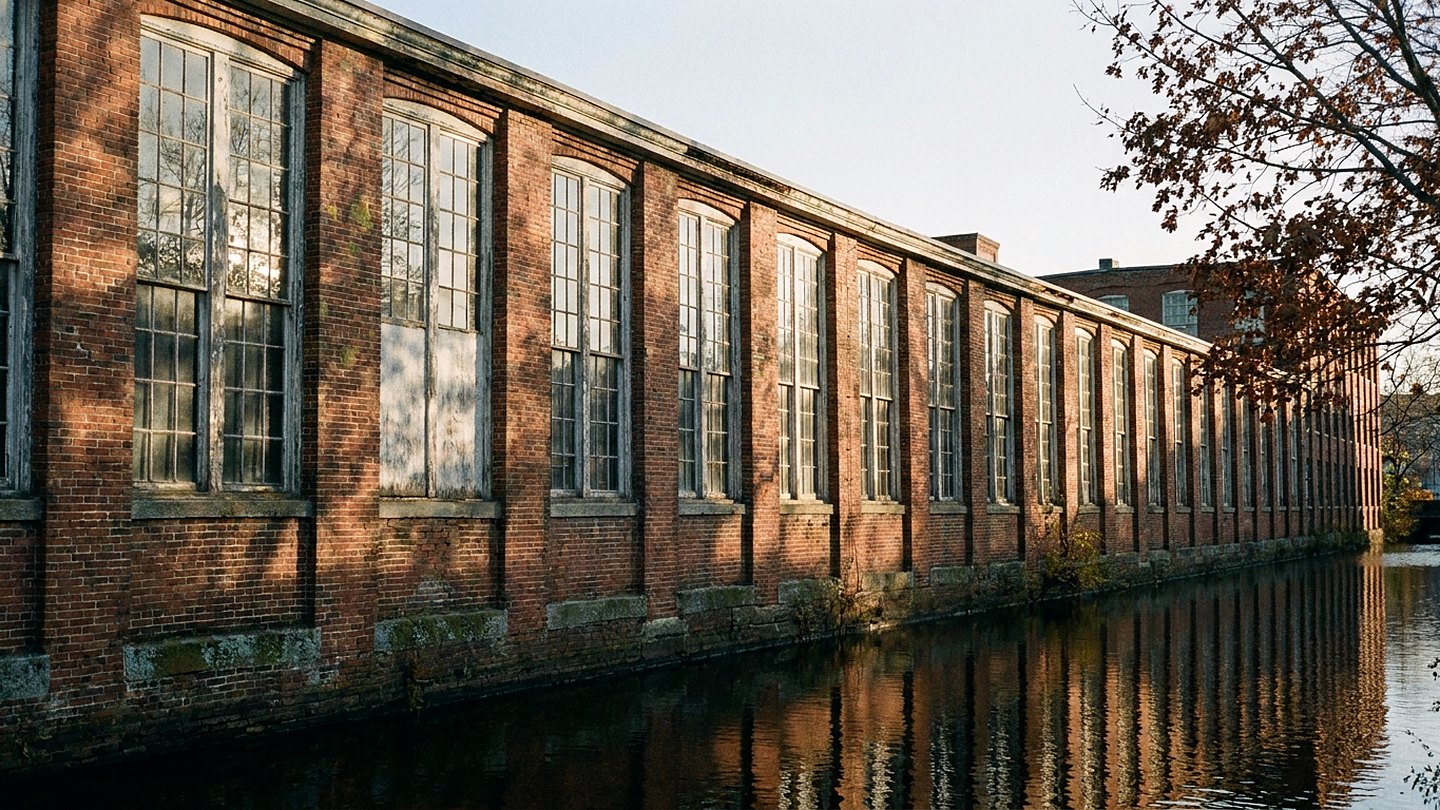
The Millyard in Four Seasons
Four visits to the same brick district in one year, one for each season. What the light does to the walls, and who is out walking when it does it.
I live a twenty-minute walk from the millyard, which removes any excuse for calling a visit there a trip. Last year I went anyway, four times on purpose, once in each season. The rule was simple: same way in, a different season each time, and the hour left open so the month could choose it.
The millyard is a long line of brick buildings along the river, with canals cut behind them and low bridges over the water. Most of the buildings now hold offices, classrooms, and storage rooms that nobody has opened since the last lease change. The brick is the constant. Everything else rotates, including tenants, fences, and the color of the netting on the scaffolding.
I wrote down three things per visit: what the light was doing, what I could hear, and who else was out. Four visits do not make a study, and I am not pretending otherwise. They were enough to show me that this district has moods I had been walking past for years.
January: the canal holds still
The first visit was on a Tuesday morning at 8:40, with the temperature somewhere near eighteen degrees. The canal behind the long block was frozen in uneven sheets, gray at the edges and almost white in the middle. Someone had thrown a traffic cone onto the ice, where it stood upright and looked slightly embarrassed about it.
Winter light hits this brick at a low angle and turns it the color of weak tea. The mortar lines show more than usual, so the whole wall reads as a grid rather than a surface. I counted forty-two windows on the section facing the water before I lost my place and stopped.
The people out at that hour were commuters cutting through, walking fast with hoods up and cups in hand. Nobody stopped moving. The only sounds were road salt under boots and a truck idling by the loading doors. I lasted thirty-five minutes, which felt respectable given the temperature and my choice to leave gloves at home.
April: the water gets loud
April was the visit that changed my mind about the place. The river was high with snowmelt, and the falls upstream pushed enough water to be heard three blocks away. Behind the mills the canal was moving again, brown and busy, carrying sticks and one abandoned soccer ball.
Brick in April is darker because it holds the rain. Wet brick goes deep red, nearly purple in the shadowed courses, and the white window frames jump forward by comparison. Puddles along the service road doubled the walls, which is the sort of free effect that gets photographers out of bed at six.
I met two of them doing exactly that. We nodded, the way people do when they have both chosen an odd hour for the same reason. On the way out I passed a crew clearing storm grates. There was also a heron on the canal wall, standing with the patience of a much older bird.
July: the long evening
The July visit started at 7:15 in the evening, because midday between these buildings is a heat trap and I know my limits. Brick stores warmth all afternoon and gives it back after sundown, so the alleys stay warm well past nine. The light at that hour is the reason this district ends up on postcards.
Low sun runs down the length of the buildings and lands sideways, so every course of brick throws a small shadow of its own. The wall stops being flat. From the far side of the water it looks like corduroy, and the windows go from black to orange in about ten minutes.
Summer is also the only season when the millyard sounds like a neighborhood. There was a game on the field below, music from a car with both doors open, and a family arguing pleasantly about parking. I stayed until 8:40 and walked home in the dark without noticing the distance.
October: windows and reflections
October brought the clearest air of the four visits and a temperature that made the walk in a pleasure rather than a task. I arrived at 4:30 in the afternoon, which in the middle of the month leaves roughly ninety minutes of usable light. The canal was low and dark green, holding a slightly wobbly copy of the buildings.
This was the visit where I finally looked at the windows properly. The older sections have tall arched openings with granite sills, and many still hold their divided frames. Newer tenants have filled some with white blinds, some with dead plants, and one with a cardboard sign that had faded past reading.
Fall light does something specific to this brick. It warms the orange without flattening the shadows, so the walls look fired last week rather than in the 1880s. I sat on the granite steps by the water for half an hour and watched a rowing crew pass. Eight people were making a hard thing look ordinary.
What four visits taught me
The obvious lesson is that the district has one good hour per season, and that the hour moves. January rewards early morning, April rewards rain, July rewards the last hour of light, October rewards late afternoon. Arrive at noon in any month and you get a parking area with a view.
The less obvious lesson is about company. Winter belongs to people passing through, spring to people working, summer to people gathering, fall to people looking. I fit into a different category on each visit, which was humbling in a small and useful way.
I also learned that I had been wrong about the scale of the thing. From a car the millyard reads as one long wall with a chimney at the end. On foot it separates into distinct buildings with different roof lines, different window rhythms, and courtyards you cannot see from the road at all.
Going back
I will keep this rotation, with one change. Next year I am adding a fifth visit in late November, when the trees are bare and the office lights come on at four. That should let me see the windows from the outside in, which is the one view I have not had.
A few practical notes for anyone considering the same exercise. The walkways along the water are flat but uneven, with granite curbs, loose gravel in places, and no railing on some stretches. Winter ice sits on the shaded side of the buildings long after the streets are clear.
Street parking is metered during the day and free in the evening, and the lots between the buildings are private and marked as such. There are no public restrooms in the district once the offices close for the day. Bring water in July, because shade is scarce and the heat comes off the brick from both sides at once.
If you only want one visit rather than four, take the October one and start at four in the afternoon. If you want to know why the canals are there at all, the city library keeps local history material on the subject. It explains the district more clearly than any sign in the yard. Four visits later, I still cannot walk that wall without counting windows.
What I checked
- City of Manchester municipal pages describing the millyard district, its canals, and street access
- Public pages of the city library covering local history collections and reading room hours
- Municipal notices on street parking and metered hours in the blocks along the river

Asma Tarrant, founder and editor. Filed from Manchester, New Hampshire.